Town Hall
 At the southern side of the market square you will see the venerable town hall. The oldest written record of these building in Borna dates from 1439, stating that "on the evening of Our Lady's Annunciation, on Tuesday, Master Wolffart began to build the walls of the new town hall"(March 26th 1439).
However, it can be assumed that there was a town hall building before that, but it was probably destroyed during the Hussite War (1419-1436). The town hall was not only used for administrative purposes. It was also a busy trading centre, especially for cloth and furs. It also housed the bread and meat shops and a room for the militia. The council hall was not only used for meetings, it was also used for festivities and theatre performances.
In a drawing by Wilhelm Dilich from 1628, the town hall can be seen with several Renaissance gables, which were created in the course of contemporary reconstruction work. During the great town fire of 1668, the town hall was destroyed down to its foundations and by 1676, rebuilt in its present baroque form according to a design by the Altenburg architect Gundermann.
The beautiful portal made of Rochlitz porphyry also dated back to this time and is decorated with the initials of the highest councillors and the keystone bears the Borna city crest. The oakwood door leaves are a special feature. They show grotesque masks in the cartilage style of the 17th century. Rumors said, they show the faces of the councillors, who had made their jobs very bad.
Bis 1676 wurde das Gebäude nach einem Entwurf des Altenburger Architekten Gundermann in seiner heutigen barocken Form wieder errichtet. Aus dieser Zeit stammt auch das Rathausportal aus Rochlitzer Porphyr, dessen Schlussstein das Bornaer Wappen trägt. Geschmückt ist das Portal mit den Initialen der obersten Ratsherren.
The last major alterations took place in 1887. The two oriels were added, the balcony for the tower musicians was removed and a new council chamber with a beautifully ceiling, decorated in the style of historicism was added to the eastern part of the first floor. Currently, this room is only used for certain ceremonies as it is too small for the current public council meetings.
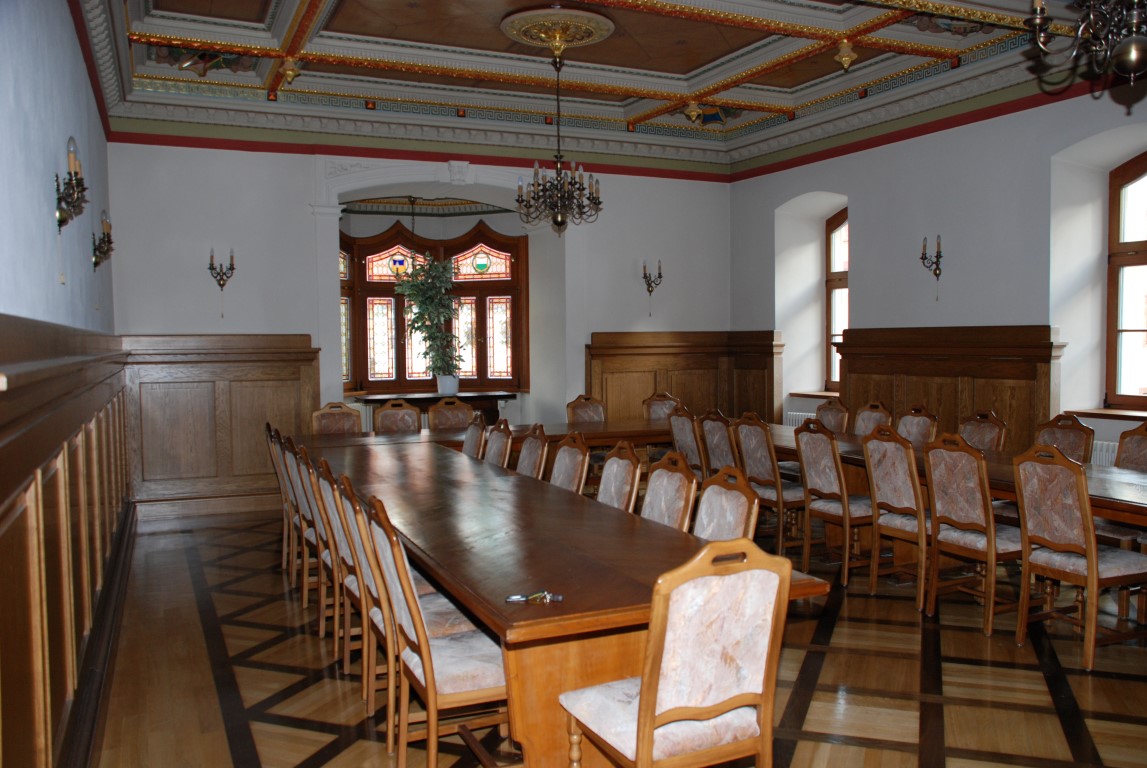
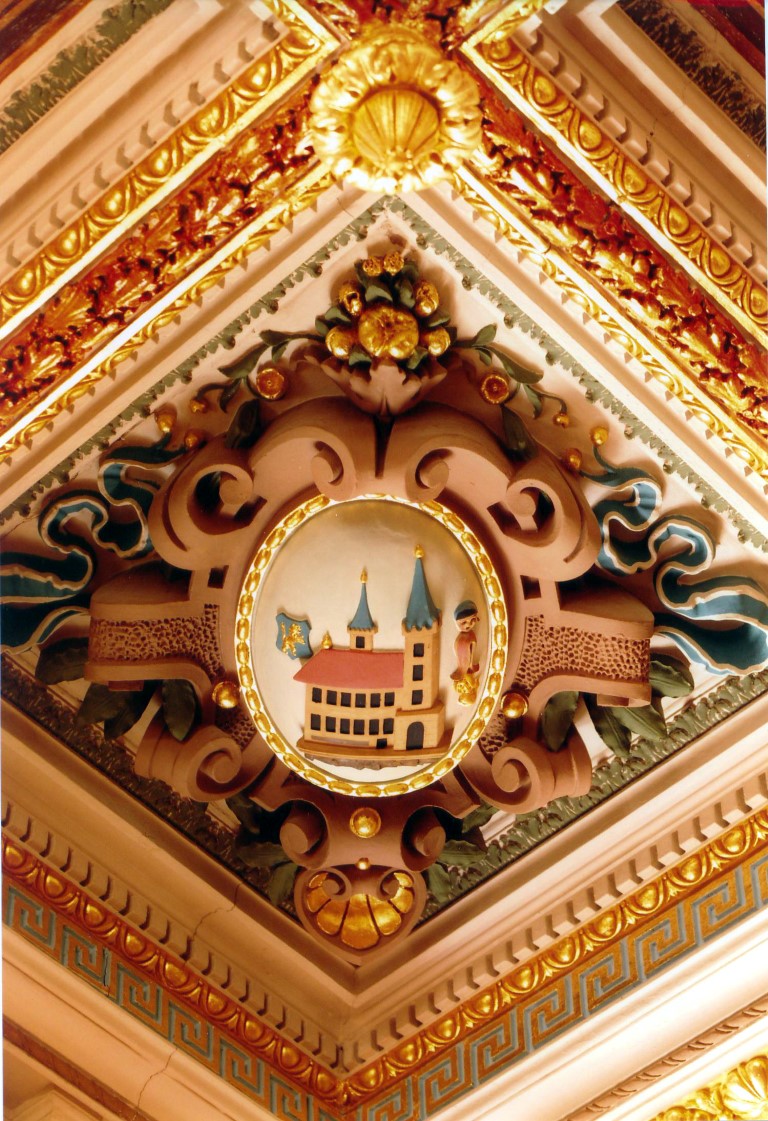
Council Chamber and City Hall ceiling
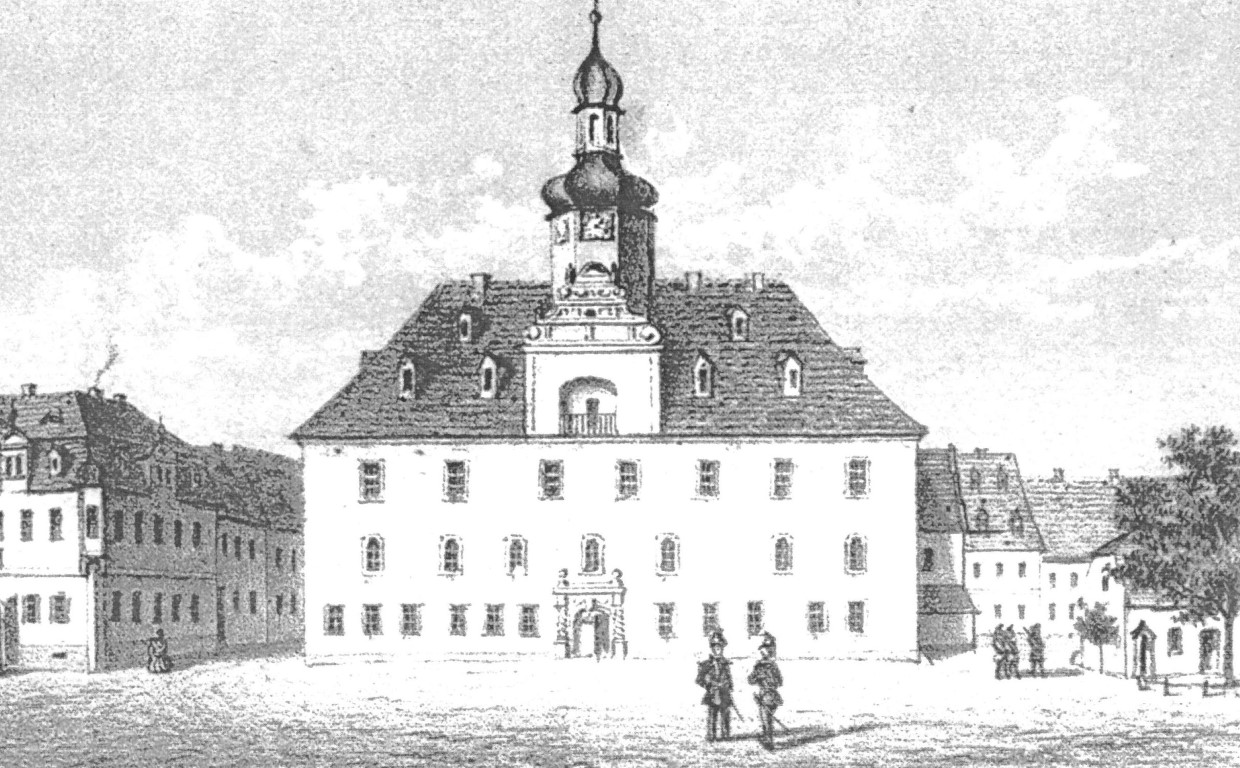
Town Hall um 1860